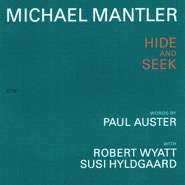
HIDE AND SEEK
ECM 1738
A Suite of Songs and Interludes
for 2 Voices
and Chamber Orchestra
words by Paul Auster
Robert Wyatt (voice)
Susi Hyldgaard (voice)
Roger
Jannotta (flute, oboe, clarinets)
Michael Mantler (trumpets)
Martin Cholewa (French horn)
Vincent Nilsson (trombones)
Bjarne Roupé (guitars)
Susi Hyldgaard (accordion)
Tineke Noordhoek (vib, marimba)
Per Salo (piano)
Marianne Sørensen (violins)
Mette Winther (violas)
Helle Sørensen (cellos)
recorded February - September 2000
Copenhagen and London

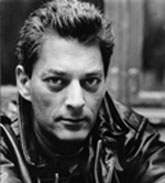
American novelist, essayist, translator, and poet, born in 1947 in Newark, New Jersey. His first prose work was the memoir The Invention of Solitude, followed by the three novels which brought him international recognition as a startlingly original writer: City of Glass, Ghosts and The Locked Room, comprising The New York Trilogy.
Since the Trilogy he published the novels In the Country of Last Things, Moon Palace, The Music of Chance (which was nominated for a PEN/Faulkner Award and also made into a movie), Leviathan, Mr. Vertigo, Timbuktu, The Book of Illusions, Oracle Night, The Brooklyn Follies, Travels In The Scriptorium, Man In The Dark, Invisible and Sunset Park.
Auster's other writings include the poetry volumes Unearth and Wall Writing, as well as essays and memoirs, such as White Spaces, The Art of Hunger, Groundwork, The Red Notebook, Why Write, Winter Journal, Here and Now and Report from the Interior. Hand to Mouth, a collection of miscellaneous writings, includes the short play Hide and Seek, the basis for Michael Mantler's composition. He also edited the collections The Random House Book of Twentieth Century French Poetry and True Tales of American Life.
Paul Auster's work has been translated into more than thirty languages and he is the recipient of several prestigious awards, including the Commandeur de L'Ordre des Arts et des Lettres and the Prix Medicis Etranger (for the best novel by a foreign author) in France, as well as the Morton Dauwen Zabel Award from the American Academy and Institute of Arts and Letters.
He has collaborated with director Wayne Wang on two critically acclaimed films, Smoke and Blue in the Face, and wrote and directed his own Lulu on the Bridge and The Inner Life of Martin Frost.
He
lives in Brooklyn, New York, with his wife, the novelist Siri Hustved.
For more detailed information see
Paul
Auster at Wikipedia.
What
did you say?
I can't remember.
Maybe I didn't say anything.
Suit yourself.
It makes no difference to me.
Do you think we'll ever find it?
What?
I said,
"Do you think we'll ever find it?"
I heard what you said.
Then I said, "What."
Oh.
You mean what.
Yes, what.
Yes, yes, now I see. What.
Well?
I can't remember.
Maybe I wasn't asking anything.
Suit yourself.
It makes no difference to me.
Published in ”Hand to Mouth” by Henry Holt and Company, Inc.
Copyright © Paul Auster 1997
Used and re-printed by permission
What
is the essence of this work?
Voices, and therefore words, plus a chamber ensemble.
The
voices?
To
me as a composer, the human voice is one of the most interesting and challenging
instruments to write for. Not necessarily in every one of its many manifestations,
but there are always (still and again) voices that I want to hear in my
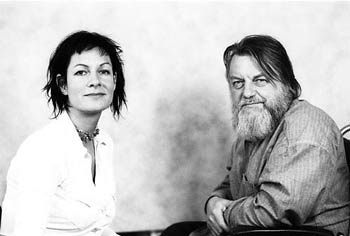
music. The by now familiar one of Robert Wyatt. A voice that's been with
me for over 25 years, yet never ceases to touch me. And a person absolutely
gratifying to work with, because of his never-ending patience and enthusiasm,
and his absolute dedication to give the music his all. As the counterpoint
to Robert I chose Susi Hyldgaard, who I first worked with during the School
of Understanding recording and live productions. She is not only
an astounding singer and personality, but also a consummate musician in
general, a rare combination. She brings an exceptional professionalism
and musicality to everything she does, something that is pure pleasure
to witness.
The
words?
In my
seemingly endless search for words to use, one author had been in the
back of my mind for a very long time. I have loved and admired the work
of Paul Auster for many years, often searching for ways of incorporating
some of his words into a piece of music. However, enjoying his work did
not mean that I found a text that would actually lend itself to be successfully
set to music. At last, "Hand To Mouth", a collection of miscellaneous
writings by Auster appeared, which included his short play "Hide and Seek".
Finally it seemed that there might be something suitable for my purposes,
and I started seriously thinking if and how this could be set to music.
And it did seem possible - not only had the words all the qualities I
usually look for in texts I utilize, such as a simple clarity and beauty
of language (a kind of "poetic" writing, without being poetry as such),
but they also retained a certain ambiguity and timelessness, which is
a very important factor for me when choosing texts. So I proceeded by
taking only some passages (as I have almost always done in the past with
other authors' work as well), whole in themselves, but not necessarily
in their original sequence, thereby reshaping the material somewhat, perhaps
creating possibilities for other interpretations. Once the texts were
found and the segments chosen, it was relatively easy to translate them
into music - since they were in fact a conversation between two people,
making the vocal duet the obvious choice, and inviting the pairing of
a very particular "cast" of interesting and contrasting personalities/voices.
The
ensemble?
What
has vaguely been referred to as my "Chamber Music and Songs Ensemble"
is now expanded, basically adapted from the more or less standard contemporary
chamber orchestra, consisting of woodwinds (here all played/over-dubbed
by the unbelievable multi-Roger-Jannotta), the string quartet now enlarged
(also old cohorts, the three "string sisters"), some added brass, low
and high (a reason to unpack the trumpet at least for a short while),
and, an important and difficult role for the piano, this time not improvising
(impeccably played by Per Salo, pianist with the Danish Radio Symphony,
and a contemporary chamber music specialist). No rhythm section/drums
(with one digitally created exception), but tuned percussion (vibraphone,
marimba) affording not only a rhythmic but also a melodic and harmonic
backbone. Plus - an integral part of all my music for some time now -
the guitar of Bjarne Roupé, the one element still retaining the largest
amount of freedom of interpretation and creative improvisational input.
And one additional, very particular instrumental color, an accordion (beautifully
played by Susi Hyldgaard).
So
once again, the question - what do you call this? What kind of music is
it?
The usual
questions, the usual problem in finding a suitable answer. Above all -
it's certainly not a play set to music. It's a musical interpretation
of someone's words, truncated, molded into something else, a personal
re-working of the material (this time with Auster's approval by the way,
since a personal contact could exist in this case - unlike with some of
my past sources for words - Beckett, Meister, Soupault, Ungaretti, etc.)
The whole formally assembled into what makes the most sense to me in this
instance, the architecture of a suite, balancing sequences of songs/words/voices
with instrumental passages, that have their own weight and drama as connecting
pieces. In this particular environment, they allow time for reflection,
though they could, and were also intended to be able to stand alone as
short and concise instrumental pieces. And what kind of music? In general,
it should be obvious to anyone who has followed the evolution of my music
(again avoiding the impossible categorization, preferably to be thought
of as a body of work by an individual that demonstrates an inherent strength
and a recognizable and unmistakable character). Specifically, in a shorter-term
view, coming directly from and a honing down of the previous recent work
with texts and singers, such as The School of Understanding and
Songs.
Live
performances?
A
theatrical multi-discipline production
has been conceived together with director Rolf Heim, involving a fusion
of musical, dance and theatrical elements on several levels. On the other
hand, the work is easily performable as a concert piece by existing ensembles
with added singers/soloists.
..... I will not hesitate to characterize Michael Mantler's new CD 'Hide and Seek' as a triumph.
Here he is back again in 'rhythmic' music, with a smaller instrumentation, and as so often in the past, where he has taken literary texts of, among others, Harold Pinter, Samuel Beckett and Giuseppe Ungaretti, as a point of departure, it is this time again a poet, the American Paul Auster, who has served as inspiration.
This is music which confirms Mantler's unique, but also vulnerable position, because of the characteristic musical language which has been with him for so many years, and which has made it difficult to tie him to any specific musical genre. But this is also music which surprises with its lushness and an expressive power, which isn't only true of the contributions of singers Robert Wyatt and Susi Hyldgaard, but to an even higher degree of the instrumental environment in which it takes place. And while Mantler's earlier works usually concerned themselves with a slow development or straightforward structures, where the sense of time seems almost dissolved, the new CD is composed as a sequence of short scenes or snapshots.
Six
of the in all seventeen pieces are purely instrumental, among them a couple,
which show a whole new side of Mantler with their rhythmic pyrotechnics.
Equally remarkable is the interplay between singing and orchestration
in the other segments, developed with a sense of variation and timbres,
which masterfully uses the eleven-piece ensemble. Especially Susi Hyldgaard's
accordion contributes its very own color, but Roger Jannotta on flute,
oboe and clarinet, Per Salo on piano, Tineke Noordhoek on vibraphone and
marimba and Bjarne Roupé on guitar are also heard in prominent
parts. The music reaches its emotional peak with 'What Can We Do?', where
one can barely listen without feeling deeply shaken.
- POLITIKEN
