ARTISTS

Over the years Michael Mantler has worked with many different artists, all contributing to his music in their own particular way. Examining the whole of his work, one finds that some keep reappearing more often than others, obviously having been of particular importance.

Carla Bley
An indispensable
collaborator and source of inspiration, she has been involved with Mantler's work
for a long period of time, not only as "third ear" and as producer
of many of his early recordings, but also as pianist (appreciated
for her originality and her exceptional musicality). On the other hand,
Mantler was also very much involved in her own music and career not only
as producer and coordinator of her work, but as performer on many of her
recording and touring projects as well. A very long mutual relationship
on a musical, business and personal basis.
Go to Discography
for all recorded collaborations,
for more
information see Carla
Bley on Wikipedia and
the WATT
website.

Jack Bruce
Although sadly no longer with us, Jack Bruce was one of the two most important and distinctive voices in Mantler's universe. After their original meeting during the production of Carla Bley's Escalator Over The Hill, they had worked together since 1973 on a number of recordings as well as live performances. He provided, almost without exception, the voice for Mantler's interpretations of Samuel Beckett's texts. He appears on No Answer, Live, Many Have No Speech (here also interpreting songs with Ernst Meister's texts in German!), Folly Seeing All This, and The School of Understanding.
For more information see Jack Bruce on Wikipedia and the Jack Bruce website.

Robert Wyatt
As
Mantler's other major and unique voice, Robert Wyatt has been inextricably
linked with his music. His whimsical interpretations of songs with Edward
Gorey's texts on The
Hapless Child are classics, on Silence
he not only provided vocals but also percussion tracks, on Many
Have No Speech he sings Philippe Soupault's texts in French (!), and
on the School
of Understanding album he contributes one central song (which appeared
during performances in a specially produced music video clip). Their last
collaboration was Hide
and Seek, an album featuring duets with Susi Hyldgaard, with music
composed by Mantler to texts of Paul Auster.
For more information
see Robert
Wyatt on Wikipedia and
the Robert
Wyatt website.
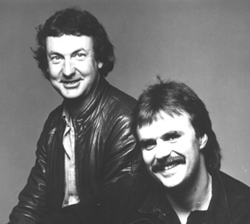
Nick Mason
Rick Fenn
Nick Mason, Pink Floyd drummer, who Mantler met first during the production of The Hapless Child, where he provided some engineering work at his Britannia Row studios, continued to be involved on several record productions (Something There, Live) as well as live performances (a radio concert at WDR in Cologne and at the Frankfurt Art-Rock Festival), providing the rock drumming Mantler had become extremely fond of during a certain period in his musical evolvement. In exchange, Mantler became involved as trumpet player (as well as recording engineer) on Mason's solo album Fictitious Sports. Their collaboration was revived with Mason appearing as soloist in Mantler's Concertos.
It
was also through him that Mantler was introduced to Rick Fenn, the guitarist
who was to continue providing the electric guitar role so important in
his music (preceded by the likes of Larry Coryell, Terje Rypdal, Chris
Spedding, Philippe Catherine and Mike Stern) during several of his next
projects, such as the Live,
Many
Have No Speech and Folly
Seeing All This albums.
For more information see Nick
Mason and Rick
Fenn at Wikipedia.

Don Preston
Keyboardist
with a great range of musicians and original member of Frank Zappa's Mothers
Of Invention, Don Preston collaborated with Mantler as synthesist
on several recording and performing projects, including Alien
(an almost entirely synthesized "orchestral" piece), Live,
(with Jack Bruce, Nick Mason and Rick Fenn) and (primarily as singer)
in The
School of Understanding.
For more information see Don
Preston at Wikipedia.

Mona Larsen
With
Mona Larsen Mantler had found yet another exceptionally interesting voice
who has contributed an unparalleled emotional depth to his Cerco
Un Paese Innocente album (singing brilliantly in Italian - not her
native language...!). She has also been a member of his Chamber Music
and Songs Ensemble (Songs
and One Symphony) and appears in an important role in The
School of Understanding.
For more information see the Mona
Larsen website.

Bjarne Roupé
An
immensely experienced musician who has performed and recorded with a multitude
of musicians and groups, guitarist Bjarne Roupé continues the tradition
of the electric (and in some instances also acoustic) guitar soloist.
Demonstrating great empathy for Mantler's music, he was a member of the
Chamber Music and Songs Ensemble and participated in the Cerco
Un Paese Innocente and School
of Understanding recordings and performances, followed by appearances
on Songs
and One Symphony and Hide
and Seek. He was the soloist on Guitar during its premiere performance
at the Berlin JazzFest, as well as on its subsequent recording released
on Concertos. His latest contributions are on For Two
(guitar and piano duets), The
Jazz Composer's Orchestra Update and, most recently, on the forthcoming
Orchestra
Suites album.
For more information go to the Bjarne
Roupé website.

David Helbock
David
Helbock, an exceptionally gifted and creative pianist, has enhanced Mantler's
music during live appearances and on record since 2013, appearing on the
Jazz
Composer's Orchestra Update and
Comment C'est albums and, most recently, participating in the Orchestra
Suites concerts (with a recording yet to be released).
For more information see the David
Helbock website.

Gérard de Haro
As important as musicians obviously are for bringing a composer's music to life, yet another element needs to be involved in producing a recording, on a technical level as well as on a creative one. Recording engineer Gérard de Haro (together with partner Nicolas Baillard) and his state-of-the-art La Buissonne studios at Pernes-les-Fontaines in the South of France, provide just that for Mantler's productions. Starting with the Concertos album in 2007, they continued to work together on For Two, The Jazz Composer's Orchestra Update, Comment c'est and, most recently, his Orchestra Suites project (yet to be released). De Haro's technical proficiency, paired with an exceptional understanding and genuine love of all kinds of music, has expanded the traditional role of the "recording engineer" as we know it and has made him an essential part of Mantler's musical universe.

Christoph Cech
Most
of Mantler's productions involve larger ensembles, ranging from chamber
orchestras of varying sizes to jazz big band. Their realizations in both
performing as well as recording contexts could only come to perfection
under the guide of a competent and enthusiastic conductor. Multi-talented
Christoph Cech - musician, orchestra leader, conductor, teacher, and composer
in his own right - has not only been the perfect, but indispensible companion
to bring Mantler's often difficult music to its fruition. Their collaboration
began in 2012, with the première of Chamber
Music Eight with the Max Brand Ensemble, continuing with the Jazz
Composer's Orchestra Update project featuring Cech's own Nouvelle
Cuisine Big Band, and on to the song cycle Comment
C'est, finally arriving at their most recent work together, the Orchestra
Suites.
For more information see the Christoph
Cech website.

Samuel Beckett
And
finally, although not a musician, the author Samuel Beckett has been of
great importance and special significance in Michael Mantler's early work.
His first use of Beckett's texts appears in the album No
Answer (segments from the novel How It Is), continuing to Something
There, which originally formed the basis for an instrumental piece,
but was later to reappear as a song on Many
Have No Speech, which also included other new texts from Beckett's
Mirlitonnades. Several of these songs resurfaced again in other
versions on the Live
album. And finally, Beckett's last poem, What Is The Word, was recorded
on the album Folly
Seeing All This, sung, as all of his previous songs with Beckett's
words, by Jack Bruce. Another interpretation of that poem was included
in and represented the conclusion to Mantler's The
School of Understanding.
For more information see Samuel
Beckett at Wikipedia.